Artworks of the years
"Every true work of art means an increase in being." - Carl Peter Fröhling
It is the works that endure. With the "Artworks of the Year," we give selected contemporary artists a permanent place at the ART-Hotel Braun. Since 2016, one work has been chosen annually to represent the respective exhibition year. Each artwork tells a story of its time, of artistic questions, and of the special connection between art and location. Over the years, this has resulted in a growing collection that shapes the hotel and continually invites visitors to pause and reflect.
2016 - Thomas Baumgärtel
https://bananensprayer.de/
In the thirtieth anniversary year of the Spray Banana, ARTKibo® presented two in the spring of 2016.
Projects with Thomas Baumgärtel, internationally known as the Banana Sprayer, in
Kirchheimbolanden.
In the presence of the artist, the presentation of the largest [items] took place on May 12, 2016.
Spray painting took place on the facade of the Hotel Braun in Kirchheimbolanden. Afterwards, in
Kunstraum Holzmann opened the exhibition SCHILDERWALD, also by Thomas Baumgärtel.
The double exhibition exemplified the versatility of the artist, whose work, besides
Street art actions and projects also include drawing, printmaking, photo collages, performances and
This includes happenings in public spaces.
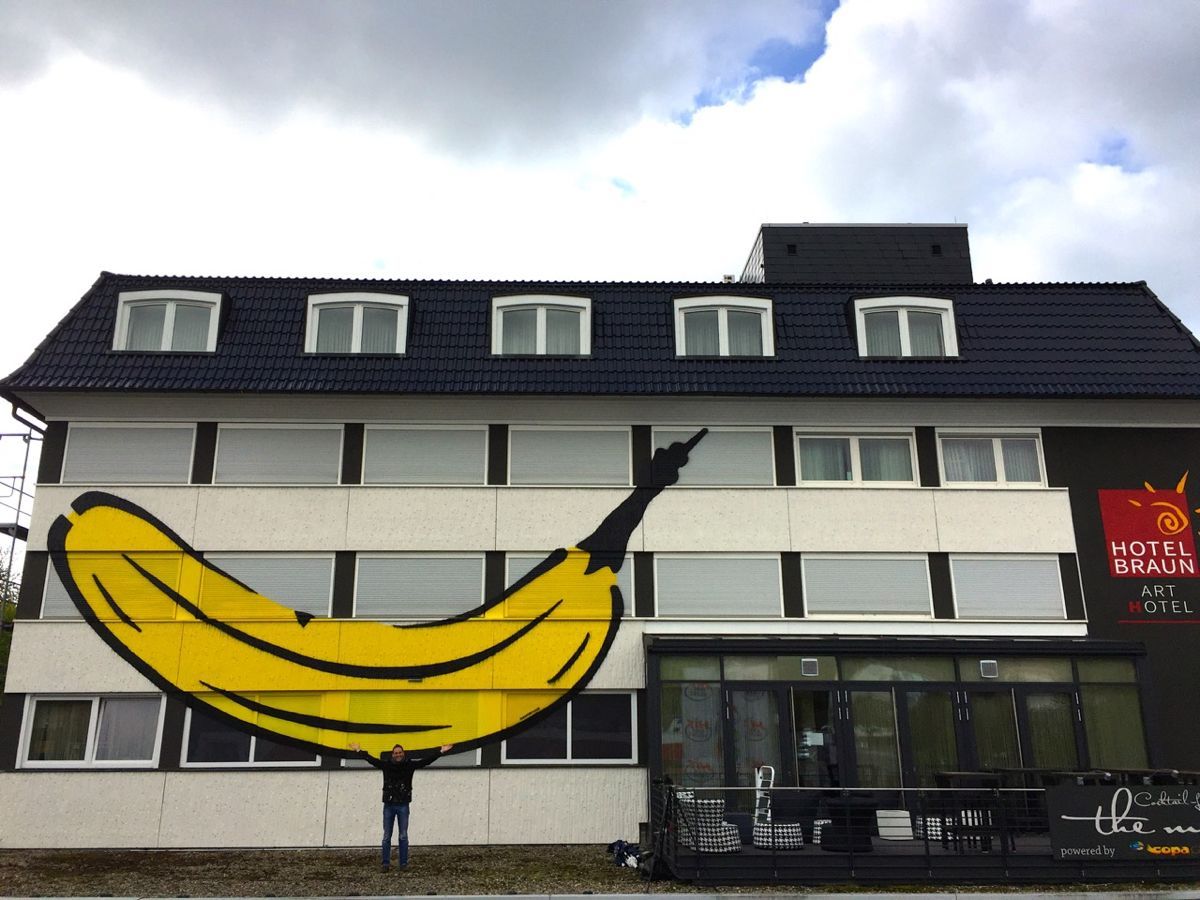
The spray-painted banana on the facade of the Hotel Braun
Banana place, more precisely, the location of the world's largest spray banana by Thomas Baumgärtel.
Being here is an unexpected gift for Kirchheimbolanden, especially if it is a
It is a private civic project that adds another attraction to the city.
and benefits all citizens.
The banana is 14 m long, 7 m high and therefore huge, sprayed onto the facade of the Hotel Braun.
–
Is this a joke?
Every spray banana by Thomas Baumgärtel is a gag, but it is more than that.
Thomas Baumgärtel has been producing and reproducing his spray banana since 1986. The first banana
The artist sprayed it anonymously on December 12, 1986, in his hometown of Rheinberg. Since then, he
Active worldwide, an itinerant art marker, as one critic (Klaus Fleming) calls him, and has after
In their own words, the largest permanent exhibition in art history outside of museums and
Galleries created.
There are at least as many keys to understanding the spray banana as there are spray bananas.
Artistic, sociological, psychological and brand-psychological, economic, political
or sexist interpretations compete with each other. I would like to briefly highlight four of them in order to
to further revive the debate about the Kibo banana, which has already been intensely debated.
The banana as a work of art
The banana as a label
The banana as a modern-day thesis poster
The banana as a symbol of a lifetime achievement
1. The banana as a work of art
The graffiti of the banana, 35 cm long, with a clear image motif, requires artistic talent.
Thomas Baumgärtel can draw. However, he sprays his bananas using a stencil, making them
It can be reproduced as often as desired. He deliberately forgoes exclusivity, the original, and relativizes it.
This undermines the idea underlying the traditional Western concept of art. All the more so
The location of each spray banana is weighted. For this purpose, the artist chooses a specific one.
A place that is part of a network and an overall concept. The artwork is thus defined in
Combination with the location where the artist places it.
Since 1986, Thomas Baumgärtel has been spraying his banana on the exterior walls of museums and galleries,
to mark these places of art for all to see. In the very beginning, it was the people of Cologne.
Galleries, in 1992 there were nine spray-painted bananas for Documenta IX in Kassel; in 1993 he drew
Baumgärtel identified forty art venues in London as the most interesting, followed by sixty in New York.
City. In thirty years, Thomas Baumgärtel has sprayed more than 4000 bananas, and thus, according to
In their own words, the largest permanent exhibition in art history outside of museums and
Galleries were created. Because access to the banana is free, even for those who usually
1. Do not set foot across the threshold of such a cultural institution. The unambiguous
The underlying message is: "Art is for everyone – art knows no boundaries".
2. The spray banana is a label.
It is a symbol of our consumer world, in which the mark on the article, the trademark, the
The item is styled as a "branded product" and its value is increased regardless of quality.
For more than thirty years, every Chiquita banana has – almost obsessively – borne a sticker that
Quality is suggested more than guaranteed. With the spray banana, the artist, who, besides the
Studies in Fine Arts in Cologne (master student of Prof. Franz Dank), also studies in
has completed a degree in psychology, referring to the hidden mechanisms of labeling and selling.
and urges the viewer to adopt a critical perspective. As if to say that the freedom of art is
a vision whose realization we ourselves hinder with our lifestyle habits. It harbors
There's a touch of irony in the fact that Thomas Baumgärtel himself became a brand on his creative path.
Banana, and the banana has become his unmistakable brand. With this, he reminds us
to Petrarch (1304-1374), poet and diplomatic genius on the threshold of the modern era, to whom precisely this
He succeeded. Through his literary work, Petrarch created himself as a free individual, independent of
He was completely independent of any real dependence on princes and patrons. He was the architect of his own destiny, fictor sui ipsium.
(Karlheinz Stierle).
3. The banana as a thesis poster
If we only see the gag or the brand in the mural, then we miss the political aspect.
The dimension of graffiti. The spray-painted banana is social criticism in visual form, understandable to everyone.
regardless of language, culture, social position, gender and age, a kind
Contemporary posting of theses. Ever since humanity began communicating in images and writing, this has been the
A common form of information dissemination and, at the same time, an invitation to dialogue. This includes the
large Renaissance frescoes as well as Luther's campaign in Wittenberg. One
Theses posting, which is closely linked in content to Baumgärtel's message and took place this year
I would like to highlight one anniversary here.
The Italian humanist Pico della Mirandola (1463-1494) also sought dialogue on the delicate issue.
The theme of individual freedom. In 1486, 500 years before the first spray-painted banana...
Baumgärtel invited Pico the scholars of the universities of Europe to Rome for a public
Discussion of his famous speech "On the Dignity of Man". The invitation was to be extended via
A public posting of 900 theses was planned. However, the planned event was cancelled.
Criminalized as heretical by the papal curia. Flight and arrest followed. What remains is...
The speech “De dignitate hominis” remains, but the substantive questions about freedom and dignity have persisted.
of man, 530 years ago in the scientific language of the elite, in Latin, today de-
alphabetized and democratized in banana shape and thus as universally accessible,
Barrier-free educational experience freely accessible to all.
After the philosophical digression comes the kicker – coincidence or providence?
4. The banana as a symbol of concrete life achievements
The spray-painted banana, after a thirty-year odyssey, is now on the wall of a large house.
Banana experts landed. The hotel's builder had spent nine years in Central America.
He's in the banana business. It's hard to imagine a more authentic approach. The circle is complete.
The banana has grown "big"; one could say it has found its home in Kirchheimbolanden.
found. The trademark, which always has something artificial about it, becomes a symbol of a
Life's work.
If, as mentioned at the beginning, the banana together with the place where it stands, the
If the artwork in question is the spray-painted banana on the facade of the Hotel Braun, then it is a work of art.
A complete work of art and by no means a gag.
Dr. Lydia Thorn Wickert l thornconcept
09.07.2016
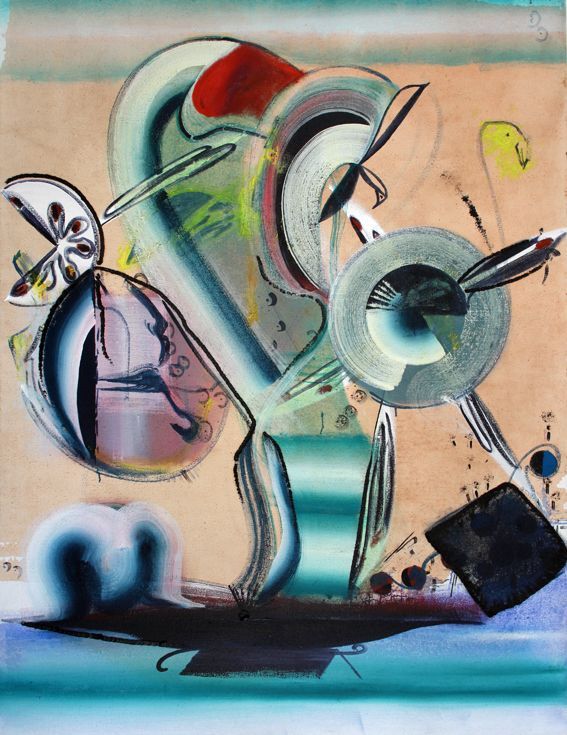
Untitled, acrylic and oil on burlap, 215 x 160 cm, 2016
2017 - Ann-Kristin Hamm
https://www.ak-hamm.de/
With the “Artwork of the Year 2017”, the Hotel Braun – ART Hotel will launch a new program on January 29, 2017.
a new event tradition and presents ARTKIBO as part of the New Year's reception
A work of art that will be exhibited in the hotel for a year and is not only accessible to hotel guests.
but also visitors from outside (Mon to Fri 8am to 11pm). The aim is to make Kirchheimbolanden
It serves as a supra-regional meeting place for artists and as a place for fruitful discussions.
to raise awareness of contemporary art. ARTISTS TO KIBO is the motto.
In collaboration with the Düsseldorf gallery Rupert Pfab, the choice was made after an extensive process.
Search "across the country" this time focusing on the
Paintings by the Berlin artist
Ann-Kristin Hamm:
oT, 2013, acrylic and oil on burlap, 215 x 160 cm.
Ann-Kristin Hamm (born 1977 in Mönchengladbach, now lives and works in Berlin) has at the
She studied painting at the Düsseldorf Art Academy under Dieter Krieg, becoming his master student in 2002.
and with Albert Oehlen. In 2004 she received her academy diploma. Ann-Kristin Hamm is a
extremely productive freelance artist and can already achieve a [benefit] after just a decade
remarkable list of solo shows and participations in group exhibitions as well as
have received awards.
"Her large-format paintings display a remarkable vehemence that contrasts space."
and two-dimensionality, advancing the seemingly figurative and the abstract. Her art creates
Confusion. It never takes concrete forms; rather, it triggers memories of familiar things.
such as snails, butterflies, blossoms, or fans. The images evoke associations, but never actually show anything.
concrete things. Like a game with shapes and colors, the images dance between abstraction and
Objectivity. Chance is used as a design principle, for example when splashes of color are used.
or splashes appear, rivulets of poured paint are visible, or traces of
Sneakers that seem to have carelessly landed on the canvases.” (Rupert Pfab).
On the day of the presentation of the large-format painting by Ann-Kristin Hamm, the exhibition will
Gesine Kikol (born 1976, lives and works in Düsseldorf) has finished her book “Total Vanitas. Yeah!”
The solo exhibition “In the Garden of Earthly Delights” on the occasion of the 2016 Night of Culture at the Holzmann Art Space was
a knowledgeable, creative and humorous exploration of the work of Jerome
Bosch and had attracted considerable attention from both art enthusiasts and connoisseurs.
An introduction by Günter Minas is available upon request.
There are some parallels in the biographies of the two artists, who are almost the same age, and yet
Their work could not be more different. Gesine Kikol, a student of Immendorff, will
be present and present some thoughts on the painting by my colleague Ann-Kristin Hamm. Art
Viewing a work through the eyes of an artist provides exciting impulses for one's own interpretation of the image.
Dr. Lydia Thorn Wickert l thornconcept.
January 2017
2018 - Martin Noel
https://martinnoel.de/
To mark its New Year's reception, the ART Hotel Braun presents the artwork of the year 2018. This year's selection is the photographic work "January" (Diasec, 90 x 120 cm, edition of 6, private collection) by Martin Noël (1956-2010) from 2006. It replaces the large-format abstract work by Ann-Kristin Hamm. It is an extraordinary gift that Margarete Noël, who manages and protects her late husband's work with competence and care, has made the photograph "January" and three series from Martin Noël's graphic work available for the exhibition project in Kirchheimbolanden. This contrasts with the last group exhibition, "Not in My Kitchen!" With five artists whose diverse materials and forms of expression constantly opened up new and intriguing perspectives, Martin Noël's small-format prints focus the viewer's gaze, directing it to lines and areas of color and, from there, into the depths of the work. The titles of the series, such as "Venice" or "New York Lines," refer to travels and artist residencies during which the artist collected his motifs and recorded them in sketchbooks and photographs. Martin Noël is one of Bonn's most renowned contemporary artists. Born in Berlin in 1956, he found his way into the vibrant independent art scene of the West at a very young age and studied painting and graphic arts at the Cologne University of Applied Sciences from 1980 to 1987, graduating as a master student. He has received numerous prizes and scholarships, including the "Junger Westen" Art Prize in Recklinghausen and the City of Bonn Art Prize. Martin Noël is also well-known in the Palatinate region: in 1993, he was awarded the Perron Art Prize of the City of Frankenthal, and in 1995, he received the Pfalzgalerie Kaiserslautern Prize for classical techniques in original printmaking, which led to museum acquisitions a few years later (1999). Martin Noël has steadfastly pursued his own artistic path. In times of impulsive color battles or sometimes seemingly arbitrary installation art, he explores line and surface. This search logically leads the artist to woodcuts and linocuts. He follows in the footsteps of HAP Grieshaber and becomes a renewer of a traditional medium. After the printing process, the artist reworks the printing blocks of his prints, giving them the status of originals. Thus, at the beginning of the 1990s, a new genre of pictorial objects emerged: the "wooden" works. Martin Noël's photographs developed into an independent genre. Here, the camera is, as it were, an extension of the eyes. Lines are magnified to the point of resolution; the viewer sees colored surfaces, color nebulae (Ferdinand Ullrich), "color essences of the real world" (Elisabeth Volk). Noël's magnifications of objects effect a shift in the viewer's perspective. The artist's close relationship to music and literature finds its artistic expression in the design of CD covers and book jackets. Margarete Noël will be present. Dr. Wenzel Jacob, a member of the founding staff and the first Managing Director of the Art and Exhibition Hall of the Federal Republic of Germany in Bonn, will speak at the exhibition.
Dr. Lydia Thorn Wickert | thornconcept.
11.12.2017
"January" photograph, on Diasec, 2007, 90x120 cm, 1/6
Cupido, 45 x 63 cm, C-Print mit Diasec, 1/10 2 AP
2019 - yutao gao
http://www.gaoyutao.com/
On Sunday, January 27, 2019, at 11 a.m., the artwork of the year 2019 was presented at the traditional New Year's reception at the ART Hotel Braun in Kirchheimbolanden:
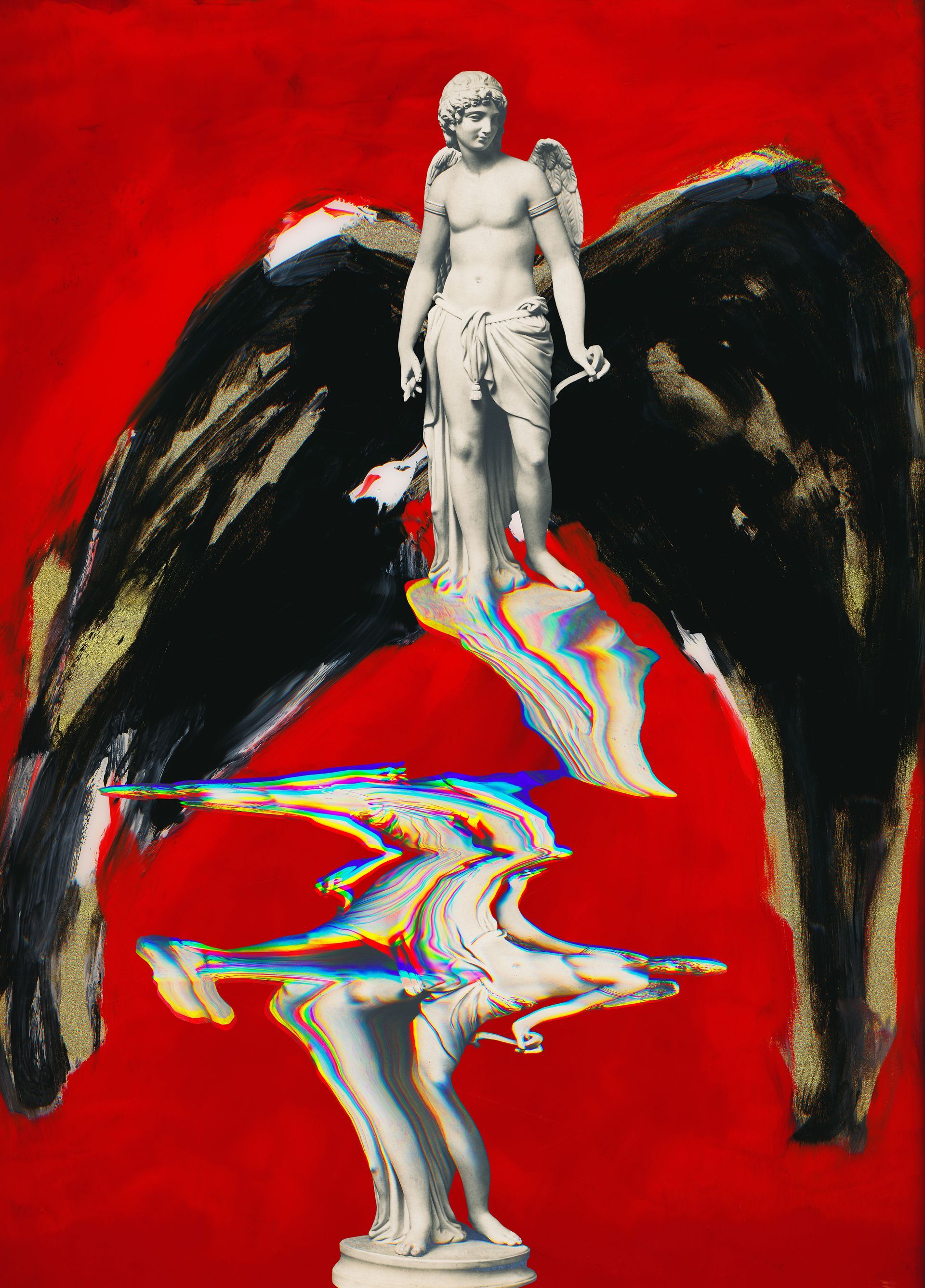
CUPIDO 40 x 55 cm C-Print, Diasec (2016) This work was created by Yutao Gao, whose other photographic prints are also on display in the hotel. Born in China in 1988, Yutao Gao initially studied at the Sichuan College of Fine Arts in the southwestern Chinese city of Chongqing (2007-2011) – one of the eight most prestigious art colleges in China – and subsequently pursued a second degree at the Düsseldorf Art Academy, graduating at the end of the 2019 winter semester with a diploma – as a master student – in the class of Prof. Katharina Fritsch. In his art, Yutao Gao explores questions of surface and space, of two- and three-dimensionality. The starting point is photographs of famous sculptures from Greek and Roman antiquity, Cupid, Leto, Leda and the Swan, the Rape of Proserpina, etc., but also images of historical architectural monuments from the Renaissance and Baroque periods in Italy. Beyond the laws of geometry, Yutao Gao senses a spatial depth in the images, which he scans using a color scanner and sometimes works on extensively with acrylic paint. The result is a multifaceted, iridescent palette that spreads across the image in soft streaks, corresponding with the hardness of the marble. The artist says: “With the scanning process (ten seconds), I add time as a third dimension to the 2D world. […] I believe that between the two-dimensional and the three-dimensional world exists an unexplored, unknown world through which time rushes. This world is like a deep river that connects the visible land to the left and right behind its banks, but remains itself unfathomable. This world is much more attractive and exciting for me as an artist.”
Dr. Lydia Thorn Wickert | thornconcept. January 2019
2020 - Vanessa von Wendt
https://www.vanessavwendt.de/
Vanessa von Wendt has lived and worked as a freelance artist in Falkensee, Brandenburg, since 2012. Prior to that, she worked in Düsseldorf, Herdecke, and Mallorca. She studied Fine Arts at the Düsseldorf Art Academy, graduating with distinction in 2010 as a master student of Markus Lüpertz. The artist combines great creative talent with a penetrating intellect and a thirst for knowledge. She is driven by questions about the ultimate questions of life and the divine. Alongside her professional career and motherhood, Vanessa von Wendt is studying theology through distance learning at the Würzburg Cathedral School. An extensive list of solo and group exhibitions attests to the widespread interest in her work. Art prizes and public commissions further elevate her résumé.
Dr. Lydia Thorn Wickert | thornconcept.January 2020
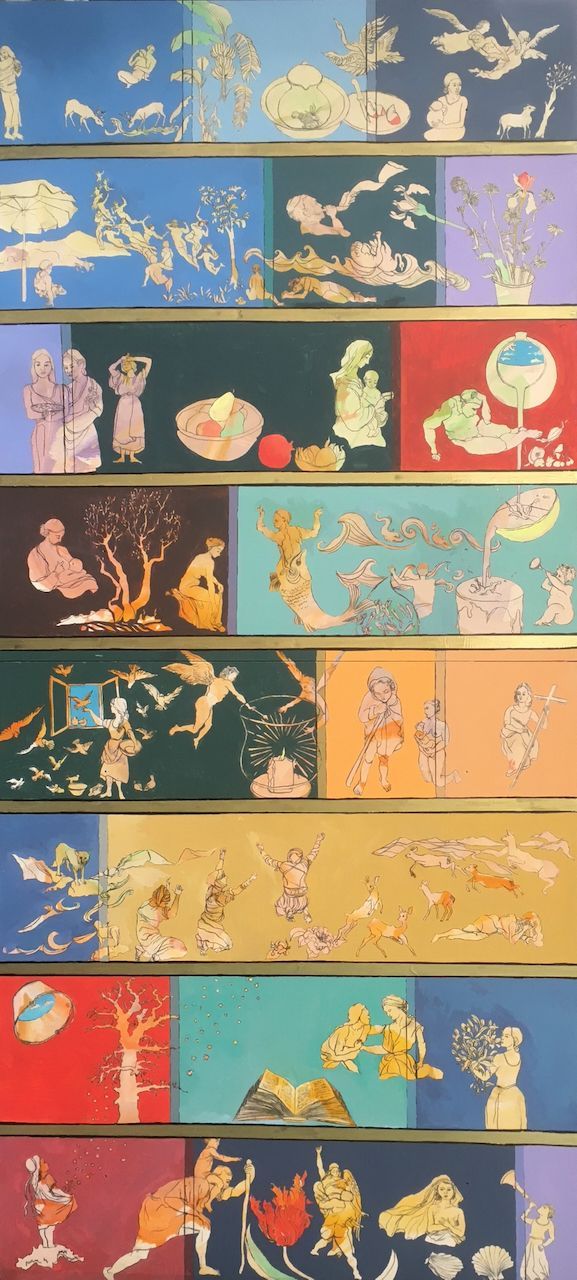
"End and Beginning", acrylic and charcoal on wood, 293 x 133 cm,
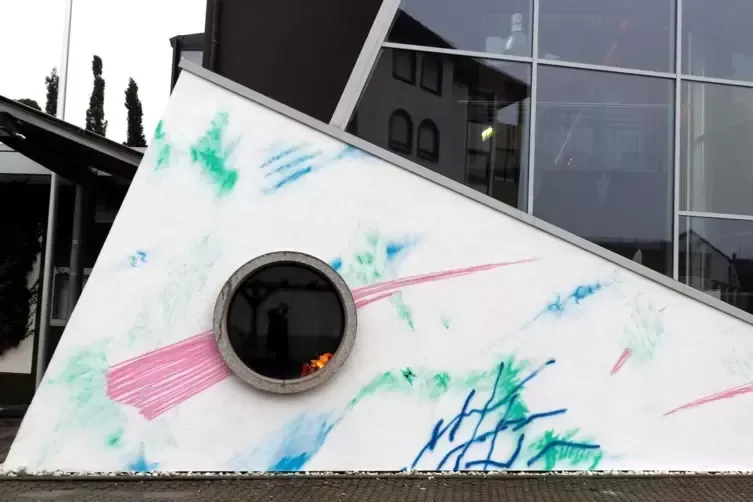
"A place in the sun", Mural Painting, spray paint on plastered exterior wall, 374 x 884 cm
2021 - Timothy Kratz
https://www.timofejkratz.de/
2022 - Silja turned
https://www.instagram.com/silja.wendt/
Traditionally, on the last Sunday in January, the ART Hotel Braun invites guests to the opening of the
A winter exhibition will be held, featuring the presentation of the artwork of the year.
This time, a work by Düsseldorf Academy student Silja Wendt was selected.
The artist is exhibiting around a dozen works made from recycled paper, painting with paper on
Canvas and a multi-part installation, also made of handmade paper, which,
partially in several layers, extending across the walls in the upper stairwell of the hotel.
The exhibition is open Monday to Saturday, 8:00 a.m. to 11:00 p.m. It runs until
August 2022.
Silja Wendt (*1996 in Münster) initially studied communication design from 2015 onwards at the
Düsseldorf University of Applied Sciences. In 2017, she switched to auditing student status and began studying concurrently in
Her main subject was painting, which she studied at the Düsseldorf Art Academy. In 2019 she was admitted to the
She was accepted into Professor Ellen Gallagher's class. Here she plans to complete her academy degree in
two years.
Silja Wendt works in the world of paper. She makes paper in self-built machines.
oversized molding frames. The result is large-format rectangular works that are attached to
Tapestries are reminiscent. In a different process, Silja Wendt pours the fiber pulp over
large plastic sheets and receive parchment-like, wafer-thin structures, which they layer.
layered on top of each other to create an abstract floor sculpture, or tacked to the wall. On this
In this way, imaginative structures are created that evoke associations with maps or the animal kingdom.
awaken. Another group of works consists of painting with liquid paper pulp on canvas.
Through a skillful yet unobtrusive hanging arrangement, the artist succeeds in...
to transform multi-story hotel buildings into a cohesive art space in which
Beyond the aesthetic dimension, new thought processes are set in motion. For the
The artist symbolizes the mutability and adaptability of paper.
Fundamental properties of nature itself. Becoming and passing away are the parameters in the eternal.
The cycle of life, in which humans are also part of the recycling process.
Dr. Lydia Thorn Wickert | thornconcept. January 23, 2022
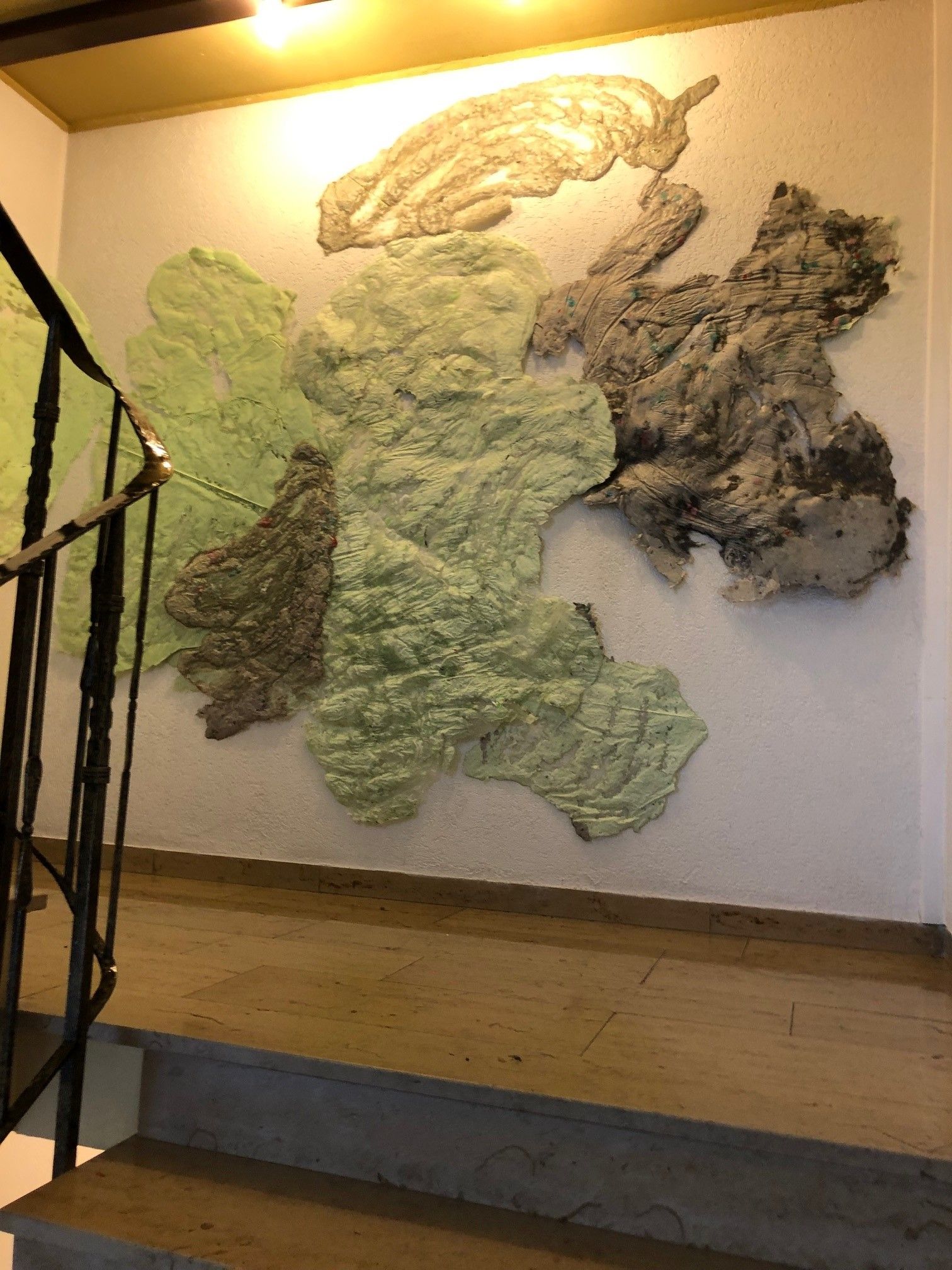
oT, recycled paper, 240 x 145 cm, 2021
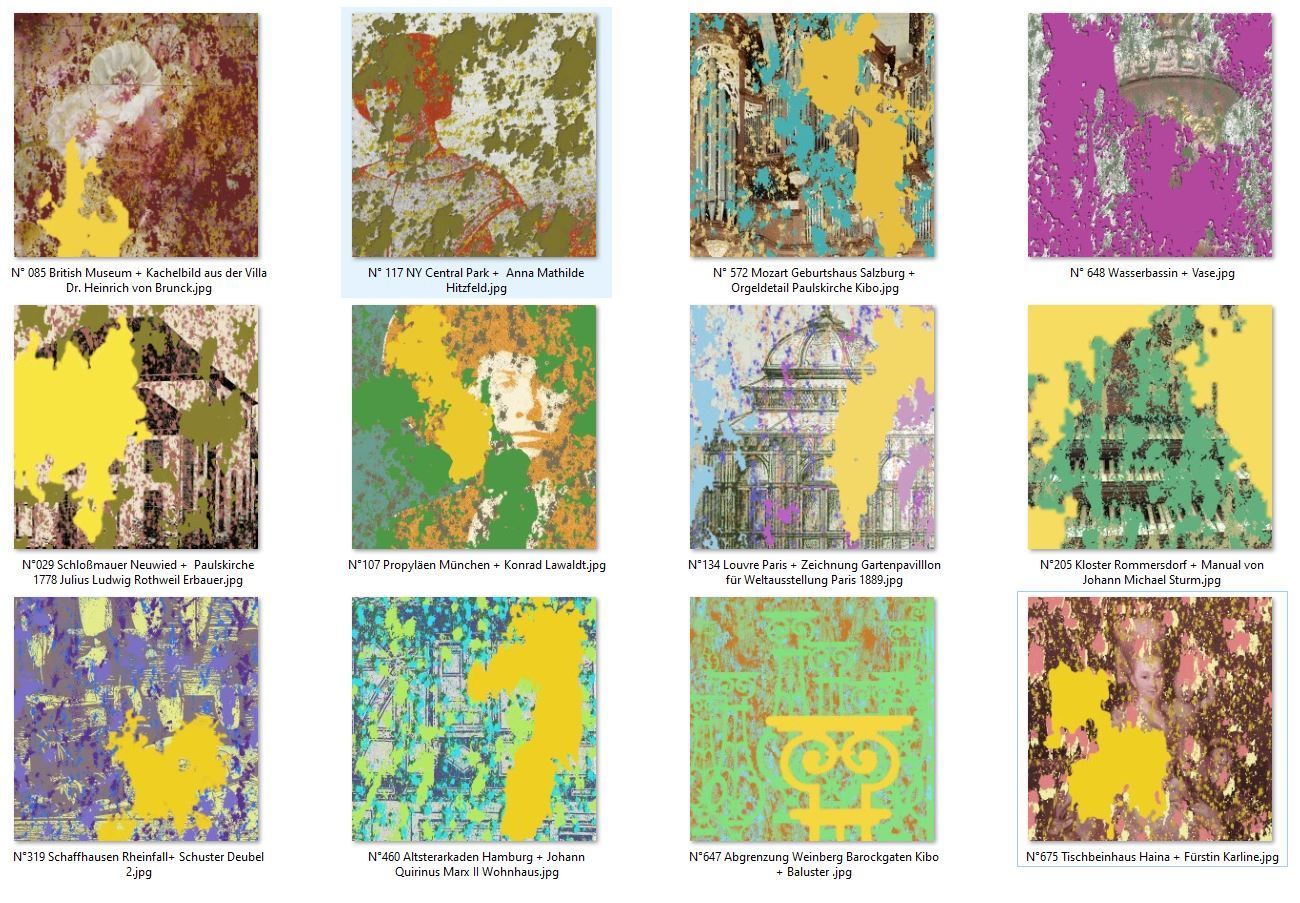
IN BETWEEN, 15 works each 15 x 15 x 6 cm, frottages, mixed media on wood, 2021
2023 - Susanne Krell
https://susanne-krell.de/
On Sunday, January 22, 2023, the ART Hotel Braun invites you to the opening of the winter exhibition and
The artwork of the year 2023 is presented within this framework. The choice fell on the fifteen-part work.
The "ZWISCHENDRIN" series of works by Susanne Krell is a real stroke of luck for the city.
Kirchheimbolanden. Because with the purchase, the unique works of art, created by people and
events from Kirchheimbolanden's past, mobility and cultural exchange
tell their stories, preserve them for the interested citizens and guests of the city, and make them publicly accessible.
The series “IN BETWEEN” was created to mark the tenth anniversary of the stonemasonry project for
an exhibition has been created in the museum in the town palace of Kirchheimbolanden and with
It was met with enthusiasm from visitors, the media, and politicians. A catalog for this
The exhibition is now available.
Now the artist incorporates the works into a new narrative that depicts the broken world order.
reflected upon and does not exclude the topic of violence and destruction. The 2019 journey with the
Artistic bridge built by Palatinate stonemasons from Kirchheimbolanden to Lviv (Lemberg) in the
Western Ukraine is currently cut off. But Susanne Krell is confidently confronting the violence with
the conviction that "beauty is a form of resistance".
The long-standing artistic engagement with the man-made hewn stone, with
Susanne Krell is ideally suited as an artist for historical buildings and the history of places.
The baroque town of Kirchheimbolanden. So far, she has created frottages in St. Paul's Church and on the grounds.
taken from the baroque terraced garden.
The artist herself describes her characteristic frottage technique as follows: “I collect traces of
Places, buildings, squares, and rooms. I collect the surface and what lies beneath it.
The history and stories, the ideas and concept of a place. As an artist, I have
Years ago I discovered frottage – a touch without distance. It is the ideal medium.
for me, from Moscow, New York, Doha, Paris, Cairo, Rome, Venice and Jerusalem, from China, the
To capture authentic surfaces from the Westerwald region and the entire world. Aesthetically interesting.
I am not bothered by the resulting black marks, dots, strokes, lines on white paper.
Nameable forms, but with verifiable origins. They have similarities and yet are
Individual and unique for the location of the idea, similar to a fingerprint. Paper and canvas.
Through the application and recording of traces, they become carriers of ideas. Thus, a collection of
Over a thousand frottages have been created so far. This collection forms the basis, the raw material for
my work."The layers of ideas, myth and history hidden behind geographical reality
They are made visible using different media, such as photography, video, projections,
Sound recordings, collages, or installations. The temporality inherent in frottages and
Historical context becomes transparent.
(https://de.wikipedia.org/wiki/Susanne_Krell and https://www.susanne-krell.de)
In addition to a university of applied sciences degree in Koblenz (1972–1976) and a distance learning course in art theory at
the University of Tübingen (1989–1990) and philosophy studies at the University of Bonn (1998–
2002) was primarily the encounter with Marina Abramovic on the occasion of her seminar Cleaning the
House (1999) had an influence on the artistic work of Susanne Krell. Since 2008, the
The artist regularly works as a curator and juror, as well as teaching. For her works
Susanne Krell has received numerous prizes and awards. She is continuously active both in Germany and abroad.
Present in solo and group exhibitions and with exclusive works in the permanent collections
The collections of the museums in Koblenz, Neuwied, and Bautzen are represented. Their current creative and
Susanne Krell has established her primary residence in the Fontane city of Neuruppin.
Dr. Lydia Thorn Wickert | thornconcept.
05.01.2023
2024 - monika kropshofer
https://www.monika-kropshofer.de/de/
Monika Kropshofer „What Truth Is“
Photography and painting
"The internationally renowned artist Monika Kropshofer (*1952 Neuwied - lives in Boppard) presents with
an exemplary selection of their altered works through painterly intervention and double exposures
Photographs.
Since 2005, Monika Kropshofer's work has been based on her large-format color photographs on
transparent, multi-layered plastic sheets that are painted and altered after printing
Landscape and architectural photography (e.g., from Iceland, Italy, China, Vietnam) will thus be brought into dialogue.
posed and questioned using simple, constructive forms, and simultaneously led to a different media level: The
Photography gains an auratic quality through the painterly intervention of concrete concepts; its reflection revolves around
about the tension between reproduced appropriation of reality and the reality of painting. Through
The painterly reworking of the photograph creates a new reality that necessarily raises the question of representation.
and raises questions about reality. This metamorphosis pushes us into a further sphere of reflection concerning relationships.
of space, time, and matter. The contrasting media used in the works create a dialectically effective effect.
Access to the work: Poetry and geometry, sensuality and concept, even space and surface are not considered as
They were not conceived as antipodes, but rather as reflections of unity.
A key characteristic of Monika Kropshofer's work is the use of double and
Multiple exposures achieve blurring, capturing several levels of reality in one image.
Similar to long exposures, the individual exposures blur into each other and the subjects become indistinct.
They often become transparent. These double exposures are intertwined metamorphoses of both subjects; they
They reflect identities in their counterparts and question their counterparts. Through the condensation of the photographic through
Through painterly intervention and double exposure, a pictorial parable about the emerges in the works.
Things of life in a merging of different time levels, places, people and ideas.
The work of the established photographer Monika Kropshofer is documented by art historical texts and
Museum acquisitions, through international exhibitions including in Vienna, Seoul, Berlin, Cologne, Hong Kong, Taipei,
Luxembourg, Dijon, Venice and Rome.” (© Heinz Höfchen; please cite authorship when quoting).
The introduction to the exhibition will be given by Dr. Heinz Höfchen, a renowned expert on the works of
Monika Kropshofer and long-time head of the Graphic Collection of the Museum Pfalzgalerie.
Dr. Lydia Thorn Wickert | thornconcept.
23.12.2023
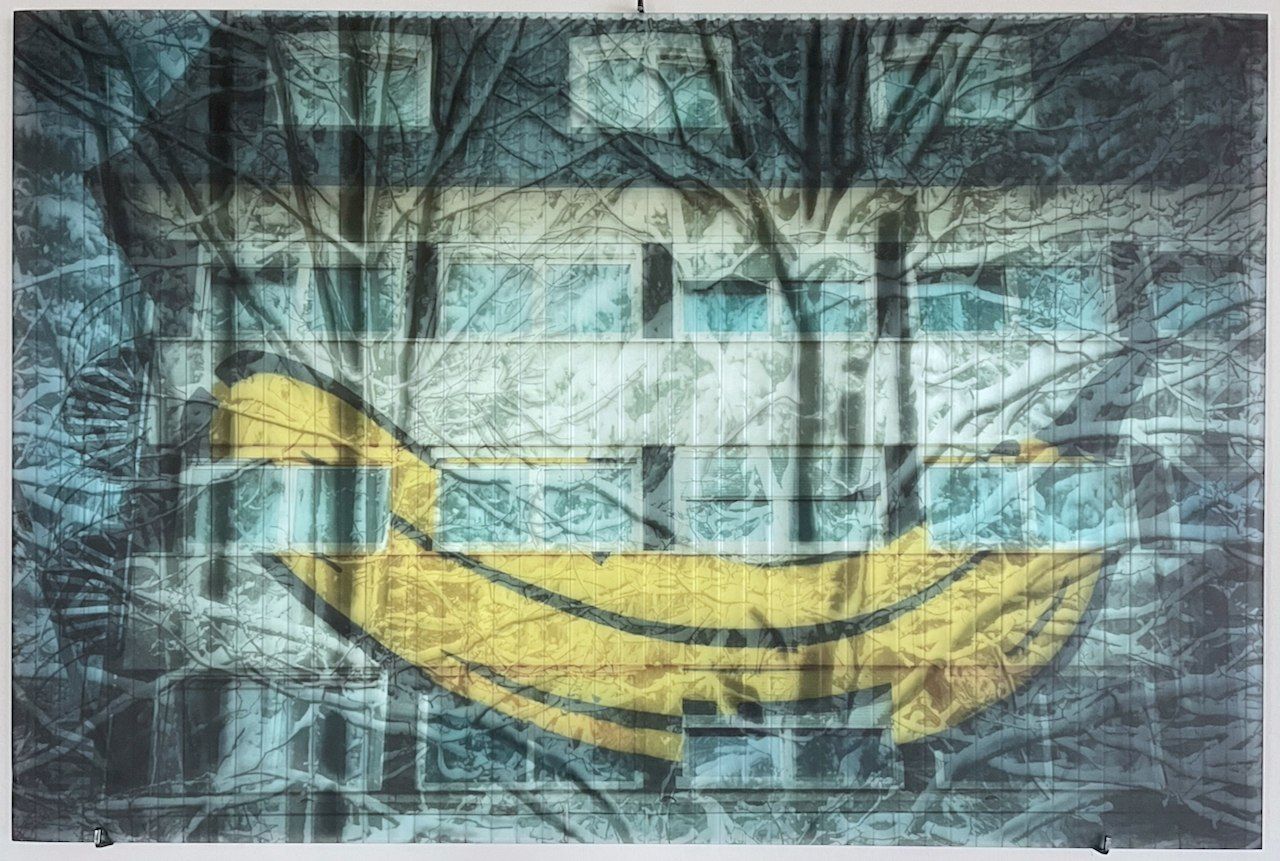
"Kirchheimbolanden ART Hotel", mixed media on digital print on plastic panel, 65 x 98 cm, 2023
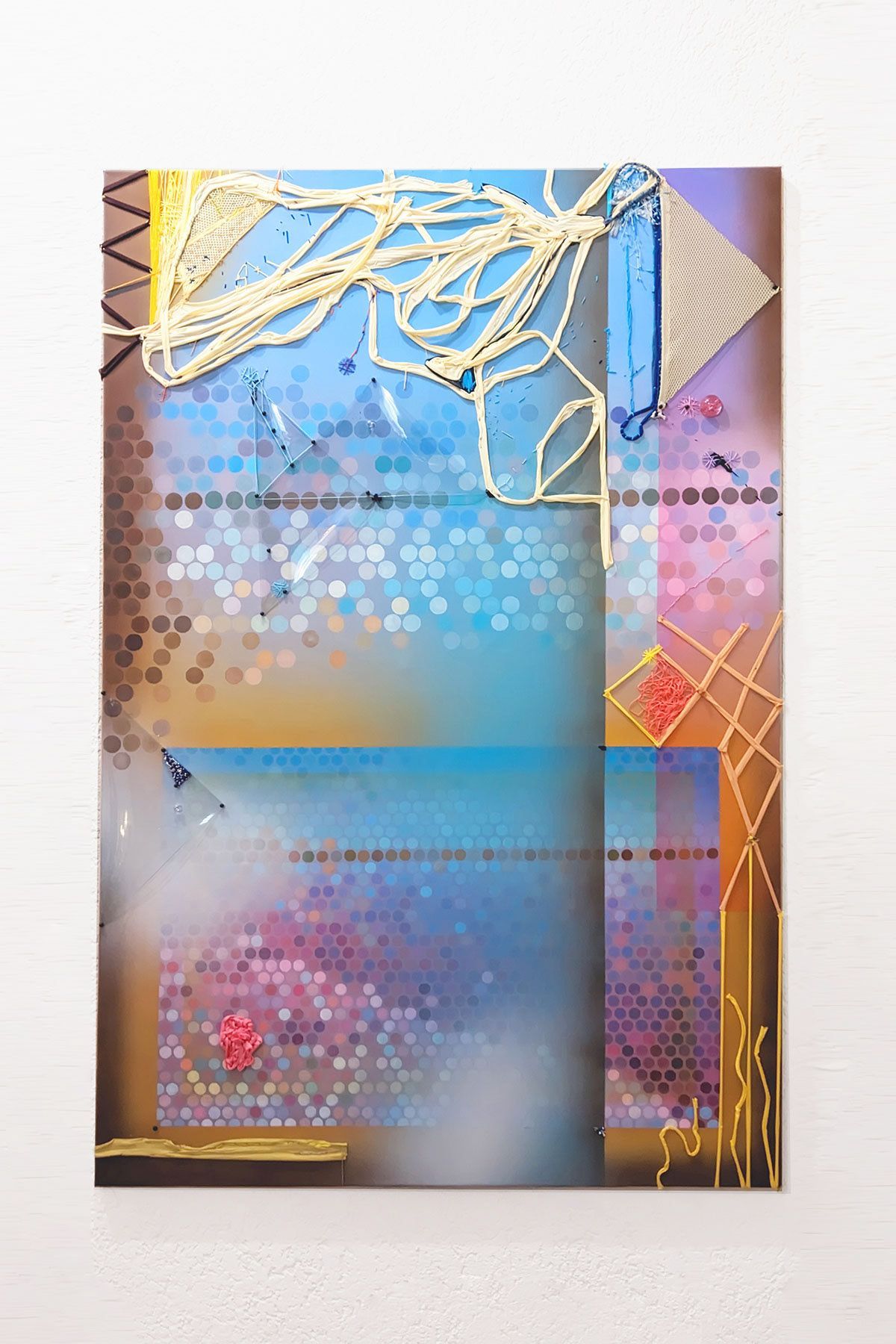
Intersection I, 150 x 100 cm, acrylic on canvas, textile yarn
2025 - oksana pyzh & bahar batvand
https://oksanapyzh.com/ https://baharbatvand.com/
On Sunday, January 26, 2025, the ART Hotel Braun in Kirchheimbolanden will open its traditional
Winter exhibition and presents the artwork of the year 2025. It is the eighteenth exhibition.
from ARTKIBO at the Braun family hotel since the installation of the spray banana by Thomas Baumgärtel
the facade, for whose anniversary in the coming year 2026 special events are already planned in the
Planning is underway.
Under the title "Intersection", Bahar Batvand and Oksana Pyzh present paintings, installations and
Objects that were largely created specifically for the ART Hotel.
Bahar Batvand was born in Iran in 1974 and completed a degree in her home country from 1994 to 1999.
She studied painting at the Islamic University of Tehran, graduating with an academic diploma.
She completed her studies. In 2000, she moved to Germany with part of her family. Here she took
In 2005, Bahar began further art studies at the renowned Düsseldorf Art Academy.
Stage design class of Professor Karl Kneidl, which she attended as a master student in 2009.
Professor Karl Kneidl graduated with distinction. Since then, Bahar has lived and worked in Düsseldorf.
Oksana Pyzh was born in Ukraine in 1989. She studied architecture and earned a master's degree in [missing information].
Kharkiv. After Putin's war of aggression, Oksana fled to Germany in 2022. She lives and
works as a freelance artist in Düsseldorf.
More than two decades apart, the two artists came to Germany
They arrived. Their paths crossed in Düsseldorf, the metropolis of contemporary art.
and they found a common language at an almost breathtaking speed.
and just one year later (2023) their first joint exhibition at the Düsseldorf City Museum
Both artists are currently featured in a group exhibition at the Women's Museum Bonn.
represented, together with Linda Nadji, who in 2014 with her installation “In the Green” the coffin storage of the
Holzmann carpentry workshop transformed into a spectacular art space.
In this “Kunstraum Holzmann” (Holzmann Art Space), Bahar Batvand exhibited ten years ago, in the summer of 2015.
As part of the Culture Night, it was shown for the first time in Kirchheimbolanden. Her exhibition was titled "On
a place" and was a powerful and courageous processing of the traumatic phase of life in Iran
and repositioning as an artist and as a woman in freedom.
The exhibition at the ART-Hotel Braun gives Bahar Batvand and Oksana Pyzh the opportunity to
to place personal life experiences in a broader context and to derive from them
to develop shared artistic positions. A large part of the work was explicitly created for the
Spatial situations created within the hotel and can be seen exclusively in Kirchheimbolanden. Sober
Perception of reality thus leads to creative activity. We in the Palatinate, who – in
in the immediate vicinity of Ramstein-Miesenbach – so far largely untouched by concrete
Despite the threat of violence, we are allowed to carry out our work and celebrate our festivals in the usual manner; the duo exhibition “Intersection” by Bahar Batvand and Oksana Pyzh serves as a gift and food for thought.
evaluate. And we can be curious to see how the two artists will approach a renowned house of
to creatively appropriate peaceful and liberal hospitality. The exhibition “Intersection” sets
a symbol of culture and freedom in the eventful history of the Donnersberg region and a reminder
not least the struggle of the Freikorps for the national unity of Germany and the idea of
Republic.
Dr. Lydia Thorn Wickert | thornconcept.
06.01.2025
2026 - Frauke Dannert
https://fraukedannert.com/
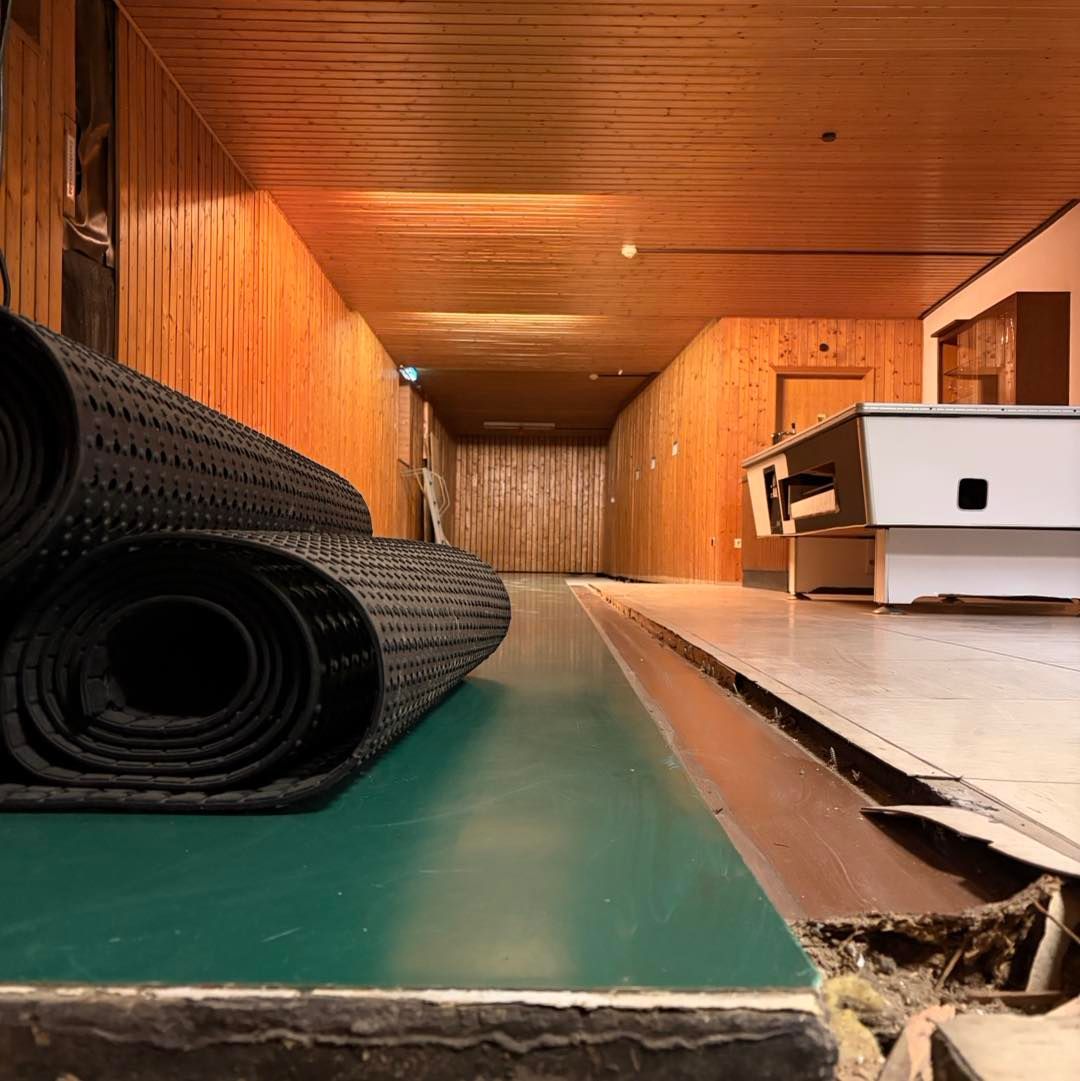
COMING SOON BOWLING ALLEY ART SPACE